What is a cezve? The small pot behind Turkish coffee
A cezve is a small pot with a long handle, and it does one job: making Turkish coffee. Coffee ground to a fine powder goes in with cold water, the pot is heated slowly, and the coffee is poured into small cups without being filtered. The grounds go into the cup too.
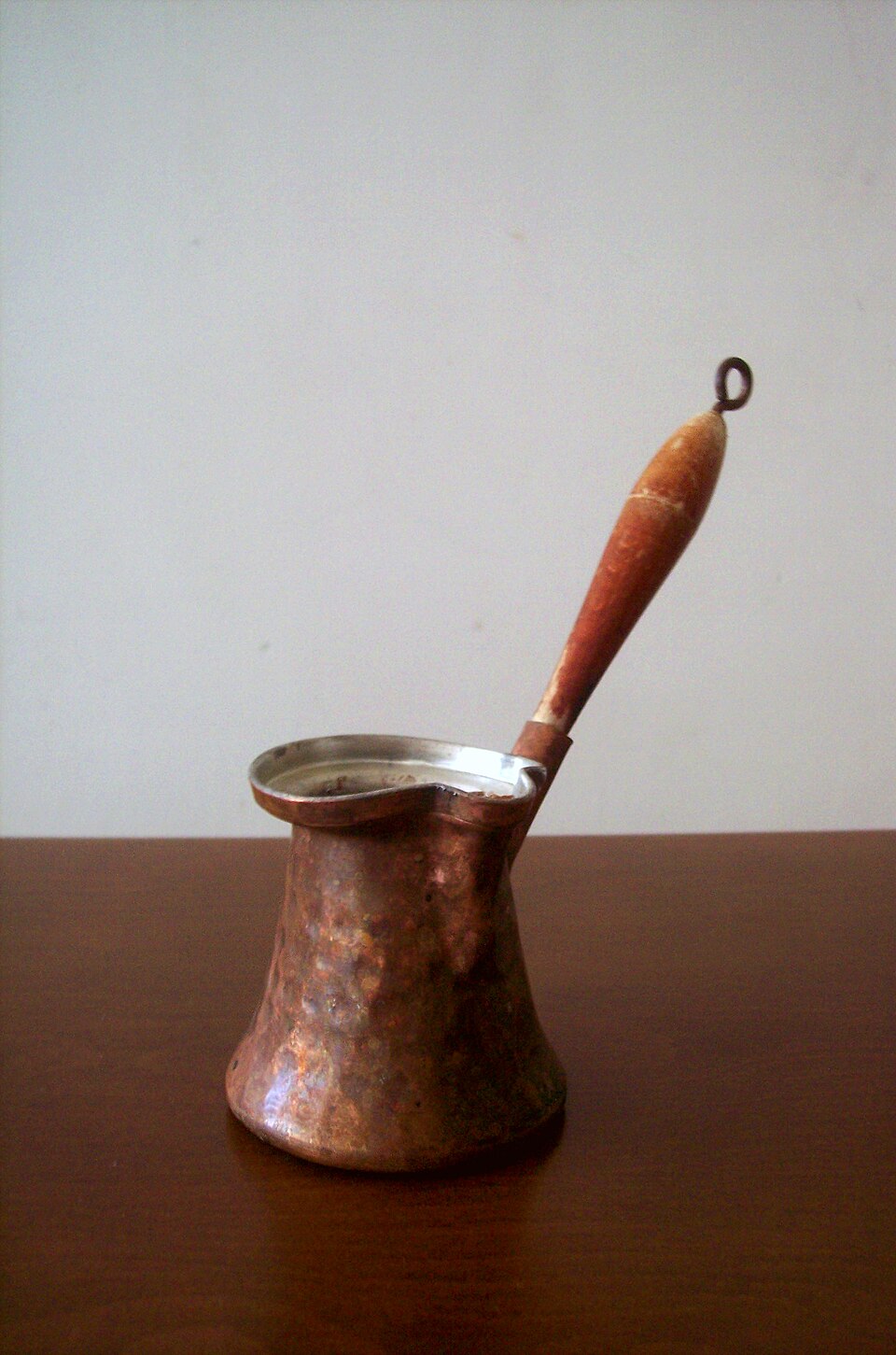
Photo: Noumenon, CC BY-SA 3.0, via Wikimedia Commons (resized). This image is shared under the same licence. File page and licence

A pot shaped for the job
The long handle is there so the pot can be set over the heat and lifted off again without burning your hand. The body is wide at the base and narrows toward the neck, and the rim has a spout for pouring. Traditional cezves are made of copper or brass.
How the coffee is made
The coffee is ground very fine, to a powder. It goes into the pot with cold water and, if you want it sweet, the sugar. Sweetness is decided before the heat goes on.
Then the pot is heated slowly, and the aim is foam. As the coffee nears the boil, foam rises to the top, and the pot comes off the heat before it boils over. Foam is treated as the mark of a well-made Turkish coffee, so it is shared out among the cups first. The rest of the coffee follows, grounds and all.
How it is served
Turkish coffee comes in small cups with saucers, traditionally with a glass of water and often something sweet, such as Turkish delight. The grounds stay behind in the cup.
They have a use of their own. In a custom that goes with the coffee, the shapes the grounds leave in the empty cup are read to tell a person's fortune.
Cezve or ibrik?
In Turkish the pot is called a cezve. Elsewhere you will often hear ibrik, and sources do not agree on whether that is right.
One coffee museum lists ibrik and cezve together, as names for the same pot. A coffee historian writing for the Specialty Coffee Association says they are different vessels, and that ibrik became a stand-in only because Europeans found the word cezve too hard to pronounce.
More than a drink
Turkish coffee is tied to the coffeehouses of Istanbul, where it was being served in the 16th century. It has long been as much an occasion as a drink: a reason to sit down and talk.
In 2013 UNESCO added Turkish coffee culture and tradition to its list of intangible cultural heritage. The pot itself is still in use in Turkey, and across the Balkans and the Middle East.
We share interesting things from around the world. We have not tested them.
Where it is used
Turkey, the Balkans and the Middle East.
Sources
- UNESCO, Turkish coffee: not just a drink but a culture
- Republic of Türkiye Ministry of Culture and Tourism, Turkish coffee culture and tradition
- Republic of Türkiye Ministry of Culture and Tourism, Turkish coffee culture (booklet)
- Specialty Coffee Association, Vessels through the ages (Jonathan Morris)
- British Museum, Life in a cup: coffee culture in the Islamic world
- EUR-Lex, product specification for Türk Kahvesi / Turkish Coffee
- Le Monde, Le cezve, l’âme du café turc
- The World Coffee Museum, cezve coffee pot
- Republic of Türkiye Ministry of Health, Turkish cuisine
- Taste of Türkiye, Turkish coffee brewed in a cezve